CPFH09 Crack Pac Flex H2O Polyurethane Crack Repair

Product Description

*For further description please see Simpson Strong-Tie Anchoring and Fastening Systems Catalog.
**Click Load Table icon for product information.
CRACK-PAC® FLEX-H2O™ Polyurethane Crack Sealer
Crack-Pac® Flex-H20™ is a high-solids hydrophobic polyurethane injection resin designed to seal leaking cracks, voids or fractures in concrete or solid masonry. The polyurethane is packaged in the cartridge and an accelerator is packaged in the nozzle. When the two are combined in the cartridge and mixed, the result is a low viscosity, water activated polyurethane. When the resin encounters water as it is injected into the crack, it becomes an expanding foam that provides a flexible seal in leaking and non-leaking cracks.
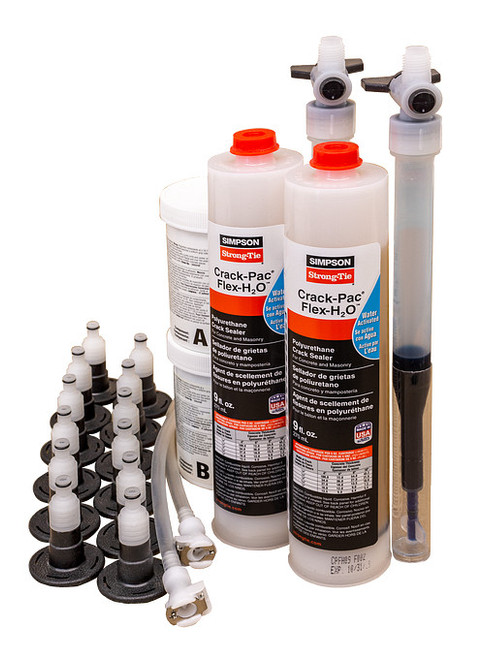
Crack-Pac® Flex-H20™ crack sealer is also available in the Crack-Pac Flex-H20 Injection Kit. The kit includes everything needed to pressure inject approximately 8 lineal feet of cracks:
■2 Crack-Pac Flex-H20 cartridge/nozzle sets
■12 E-Z-Click™ Injection Ports
■2 E-Z-Click™ Injection Fittings with 12" tubing
■1 pint of paste-over epoxy (8 oz. of resin + 8 oz. of hardener)
■4 disposable wood paste-over applicators
■1 pair latex gloves
FEATURES
■Seals seeping or mildly leaking cracks
■400% elongation provides a flexible seal for moving cracks
■Can be dispensed with a standard caulking tool
■Can also be used on dry cracks
■Can be used with a reduced amount or without accelerator to slow down reaction time
■Expands to fill voids and close off the back of the crack
■Expanding nature makes it suitable for sealing cracks in solid masonry
■Fast reacting - reaction begins within 1 minute after exposure to moisture; expansion may be completed within 3 minutes (depending on the amount of moisture and the ambient temperature).
■Non-shrinking hydrophobic formula with the elongation and flexibility of a hydrophilic resin
■20:1 expansion ratio (unrestricted rise) means less material needed
APPLICATION
Suitable for sealing cracks ranging from 1/32" to 1/4" wide in concrete and solid masonry. Can be used to repair cracks in dry, damp and wet conditions with excellent results. Designed to perform in applications where water is seeping or mildly leaking from the crack.
PROPERTY TEST METHOD RESULTS
Viscosity
(77°F) ASTM D 1638 600 cps (liquid state)
Density ASTM D 1622 Highly restricted rise - 65 lbs./ft3
Lightly restricted rise - 10 lbs./ft3
Elongation ASTM D 638 Highly restricted rise - 400%
Lightly restricted rise - 400%
Tensile strength ASTM D 638 Highly restricted rise - 2200 psi
Lightly restricted rise - 300 psi
Tear strength ASTM D 624 Highly restricted rise - 400 psi
Lightly restricted rise - 55 psi
ACCESSORIES / RELATED PRODUCTS
■E-Z-Click Injection Ports & Fittings
INJECTION INSTRUCTIONS
IMPORTANT
■Cartridge Preparation and Mixing Instructions
■Injection Guide
SHELF LIFE
12 months from the date of manufacture, unopened.
USAGE TEMPERATURE:
60°-90° F
STORAGE CONDITIONS
For best results store in a dry area between 45° F - 95° F. Product is very moisture sensitive.
COLOR
Polyurethane - clear, accelerator - green, cured - green
CLEAN UP
Uncured material – Wipe up with cotton cloths. If desired scrub area with abrasive, waterbased cleaner and flush with water. If approved, solvents such as ketones (MEK, acetone, etc.), lacquer thinner, or adhesive remover can be used. DO NOT USE SOLVENTS TO CLEAN ADHESIVE FROM SKIN. Take appropriate precautions when handling flammable solvents. Solvents may damage surfaces to which they are applied. Cured material – scrape or brush off surface with a putty knife or wire brush. Tip: wetting the concrete or masonry surface immediately prior to injection will make cured resin easier to remove.
CHEMICAL RESISTANCE
Very good to excellent against water, most hydrocarbons and alkaliis. Poor to fair against ketones, chlorinated solvents and concentrated acids.
DEFINITIONS
Dry Crack: A crack containing no moisture.
Wet Crack: A crack containing moisture (damp or containing standing water). The surface can be dried and will remain dry during the paste-over operation.
Seeping Crack: A wet crack that slowly oozes water. After being dried, the surface slowly becomes wet again.
Mildly Leaking Crack: A crack with a slow trickle of water emitting from its face.